 Sketch number 1,000!




Have great conversations about ideas through simple and insightful sketches. Visual explanations that are fast to read, fun to share, and hard to forget.

Hands down one of the most insightful and thought-provoking accounts I follow anywhere.
Love your sketchplanations — both the artwork and the visualization of ideas!
A modern library of Alexandria.
I've never missed a sketch since I subscribed. With most newsletters I'm like "pfff gotta read this". With theirs, I'm actually eager to open up the email.
In a world where it seems some people are so set on creating chaos… your Sunday Sketchplanations are just a breath of calm and peace and hope in the sharing of our common humanity.
You are my spirit animal ❤
These are brilliant… They are very inspiring for myself and my students.
Sketchplanations offers answers, enlightenment, knowledge and joy all at once!
Just discovered Sketchplanations. How did I not know about this before?
It really feels like I can become a better person with all the knowledge inside.
This account is pure gold!
Every week it makes me smile and/or think. And so often, when I'm trying to explain a concept to someone, I think "wait, there was a Sketchplanation about that!" Then I just send the person a link.
Your stuff always makes my Sundays brighter.
It's very human to want to communicate ideas and information. It's another level to communicate it simply and effectively.
You bring me visual joy.
I'm not sure if you're aware of how important what you're doing can be to those of us who struggle with basic concepts… Using imagery and cartoons to convey lessons is a game-changer for a lot of people.
I use some of the Sketchplanations as nice graphical explanations for why my software designs are the way they are. A picture being worth 1,024 words…
Beautifully short and succinct.
You have, consistently, some of the best content on the web 👏🏻
Receiving your sketch emails makes me smile and think, sends me down delightful rabbit holes.
Thank you for cutting through the chaff and making the obscure transparent.
Sometimes they arrive in my inbox at precisely the amazingly right time 😎❤️
It's been a long time since I've seen something so good on the internet.
A brilliant body of work that is genuinely inspiring and valuable to the world.
I found them very useful, and use them in my teaching.
I adore receiving your Sketchplanation emails. Creative, clever, and educational. My favorite combination.
You have a talent for brevity, clarity, and whimsy.
Reduction at its best. Provocative images and crisp text about a wide range of complex and interesting topics.
You are making the complicated clear, and doing so in a winsome way.
Was looking up Jevons paradox and discovered this gold mine of wisdom smartly visualized.
Learning one small interesting thing every week.
Your comics magically describe our thoughts in regard to Conway's Law, the Bus Factor, etc. I thank and salute you!
If there is a newsletter I always find refreshing, it is this one!
Wonderful it is to think about new things with the help of your explanations and sketches.
Great blend of feeling like a smarty pants because I learned something new and feeling warm and fuzzy because I "met" someone interesting.
Your pictures are worth 1,000 words.
I've been a fan for nearly a decade, and I'm constantly amazed by how Jono can take complex ideas — especially from behavioral science — and distill them into intuitive, funny, and powerful sketches.
Love love love your work.
I'm raising my cuppa tea to you! Thank you for making my brain smile each week.
I'm a mental health provider and sometimes share your work with clients.
By far the most interesting and best email newsletter. Intelligent, brief, succinct and clearly written, don't go changing.
Each one hits a little note in the brain.
Simple, but deep, illustrations.
"Clear is kind" convinced me to buy a coffee for the first time. This is the heart of Sketchplanations. Basics explained in a clear way: very kind.
I enjoy how you make the complex understandable with your drawings and text.
Just love your little sketchmen and your way of making sense of the world.
There's always a sketch to start any conversation with.
As someone with a very visual brain you have certainly helped me to understand the world a little better.
Read about acronyms and initialisms and I ended up saying "Oh my god!" out loud 3 times and smiling to myself.
Seriously love what you do. So smart and creative.
Great simple insights which bring a little smile and nod of the head 😀
As an academic I really appreciate your clear and generous approach to licensing!
Love the range and diversity of topics you tackle.
I read your weekly Sketchplanation with great pleasure and every time it feels like I'm learning something new.
I love how you can visually represent complex ideas and convey them in such a concise manner! When I first discovered your stuff I just wanted to print them all out as posters!
A perfectly snackable delight!
Good work that puts a smile on people's faces.
I really appreciate how the simplicity of your drawings is able to explain complicated concepts in a clear and fun way.
Fascinating facts drawn memorably.
You have created an amazing body of work! Elegant, inventive, informative, consistently high quality, dynamically varied and full of heart :)
Thank you for making big ideas small enough to fit in our pockets. You rock harder than Gibraltar 🤘
I've always loved sketchplanations, so clear and so simple.
Love your work and how relevant and timely the sketches are to work and life.
I just lost twenty minutes to Sketchplanations' tweet history. Brilliant.
They always make me smile and sometimes learn me something new. Like how to use the zipper of your backpack.
Love your work! (It makes me think, smile or both.)
Simple but powerfully impactful sketches.
If you've ever had a Sketchplanations pop up in your feed, you know just how consistently delightful and insightful they are.
Thanks for an insight and little smile at the beginning of every week.
Your art is a whimsical take on life lessons that makes one more open to understanding.
Sundays are my favorite email days when I get a new one.
You make big ideas really simple, and easy to understand and most importantly fun and easily accessible.
Always love the sketches, always relevant either personally or for work.
[I] have used some of your sketches in my ethics and political science classes.
The sketches are amazingly clear and beautiful!
Your sketches are enlightening. In a world where there are too many words being spread… you are a breath of fresh air.
One of the best illustrators I know.
There are articulations of ideas. Then there are representations of ideas that slip between the words and settle at the heart of intuition.
Your combination of text and graphics is outstanding. Keep on keeping on!
These are wonderful! I'm a napkin/whiteboard designer and these fit right in!
I have learnt (and laughed!) a lot along the way.
Highlighting some societal oddities, absurdities and wonderful wordities in a lovingly clarified claret of clarity!
I like giving away physical stickers of your sketches to my friends. It's such a delightful way to share something positive with the world.
You make my day! Every single time!
You really are putting some quality content out there to make better sense of the world one sketch at a time.
Wonderful sketches, the world needs more of this :)
I am a visual learner and so appreciate all the clarity you provide 😃
My best compliments, you're really talented (Italians say "spacchi", like "you rock").
Follow for one of these every week. It'll leave you wiser and joyful.
I really appreciate how you manage to explain complex topics while keeping it friendly.
What a wonderful idea to distil complex ideas to fit on an index card.
I admire your ability to narrow down complexity into aesthetically appealing sketches.
I love your sketches and your humor!
I found what you created really wonderful and helpful, and in line with so many truths that I've noticed in life as well. I read them all.
Love your little sketches, a small goldmine of useful stuff.
The Business archive is filled with great cheat sheets for quickly grasping important concepts.
I find your sketchplanations funny, informative, motivational and creatively stimulating.
I love receiving these newsletters. Thank you for your creativity.
I learned something: a gift for which I am grateful.
People are generally visual and your illustrations illuminate ideas much better than just text! Great work.
You make ideas clear with no apparent effort. That is a gift.
As you improve the minds of subscribers, many more worlds are made better. Aloha from Hawaii.
I love these unexpected bits of unconventional knowledge.
I show your sketchplanations when I am delivering courses. They are fantastic and a brilliant resource.
Even at the age of 91, I am learning a lot from your posts.
Your pictorial representation has helped me many times to understand the nuances in complex topics.
I love the work on Sketchplanations — it's a work of genius.
A simple but incredibly powerful way to reach out to others and communicate significant messages.
These are beautiful examples of breaking a concept down to its core.
If the world is indeed going to hell in a handbasket Sketchplanations will slow it down.
If only the entire world was explained with your sketches.
Sketchplanations are just brilliant, thank you so much for making them and sharing them with the world!
Love the page… it may just redeem the internet.
It illuminates all kinds of "things" that would otherwise remain mysterious for most kids and many bigger kids, too.
I have used these to decisively win arguments at work.
The best way to make one understand is to use as little words as possible. Cheers for doing that job well.
The weekly highlight of my inbox. Thanks for your great work!
These illustrations are some of the clearest "explainers" I've come across after months of R&D.
I like the diversity, the humor, the friendly tone, the wisdom, and sometimes the pure beauty of your drawings.
Read the whole archive today, excellent resource.
I get valuable insights from them faster than Google search.
Learning something every day is my idea of a successful life and you contribute to it in a big way.
Sharing them creates a common language of shared experience.
I stumbled upon your sketches & now have spent 2 1/2 hours looking at them. I love them so much.
Invariably the highlight of my week - keep 'em coming!
Now when I need a little brain break from work, I just open up your book and read a few — it's perfect :)
Thanks for intriguing me and enhancing my thinking.
Your work, ideas, sketches, and explanations add to my life and thousands of others each time we open them.
My new favourite way to kickstart the day inspired!
When I first came upon your site I read every single one as far as I could go. I read for nearly a whole day.
Possibly one of the best things my scrolling has ever discovered.
Thank you for making mental models and other essential ideas fun & straightforward to learn.
These things are endlessly fascinating.
If you're not already subscribed, then you should reconsider your life choices. The complex, made simple and us smarter as a result.
Every time you look at a Sketchplanations post your IQ increases by 1.
I look forward to them every week and am always excited to see what topics come up.
Sketchplanations is one of the most creative projects on the internet today.
You teach me something new every week.
I'm a high school student who looks forward to seeing your email in my inbox every Sunday… Truly a diamond found within the intertrash.
We love these sketches! Not to mention all the super interesting info. Bliss for a curious mind!
To me, your sketches are cogent, succinct mini-infographics.
I'm an author and illustrator creating one of the world's largest libraries of hand-drawn sketches that make complex ideas easy to understand.
Sketchplanations have been shared millions of times and are used in books, articles, classrooms and presentations around the world. Explore nearly 1,000 sketches explaining ideas from psychology and science to business and everyday life.
A new sketch every week since 2013. Now 1,000! 🎉
Sketch number 1,000!
 EBEH: Easy, Build, Easy Hard, Repeat
 Additive and Subtractive Colour, RGB and CMYK
 The Free-Rider Problem
 False Needles in Haystacks
 The Cloze Test
 Beyond mountains, there are mountains
 The Ordering Problem: Reasonable decisions that lead to dumb outcomes
 A Year From Now, You'll be Grateful You Started Today
 Petrichor: the smell of rain on dry ground
 Buridan's Ass
 The Wisdom Paradox
 Thumbtrap
 Night owls and early birds
 The Rose Bush Rule
 Endonym and exonym
 Melody and Harmony
 Fast Pool, Slow Pool
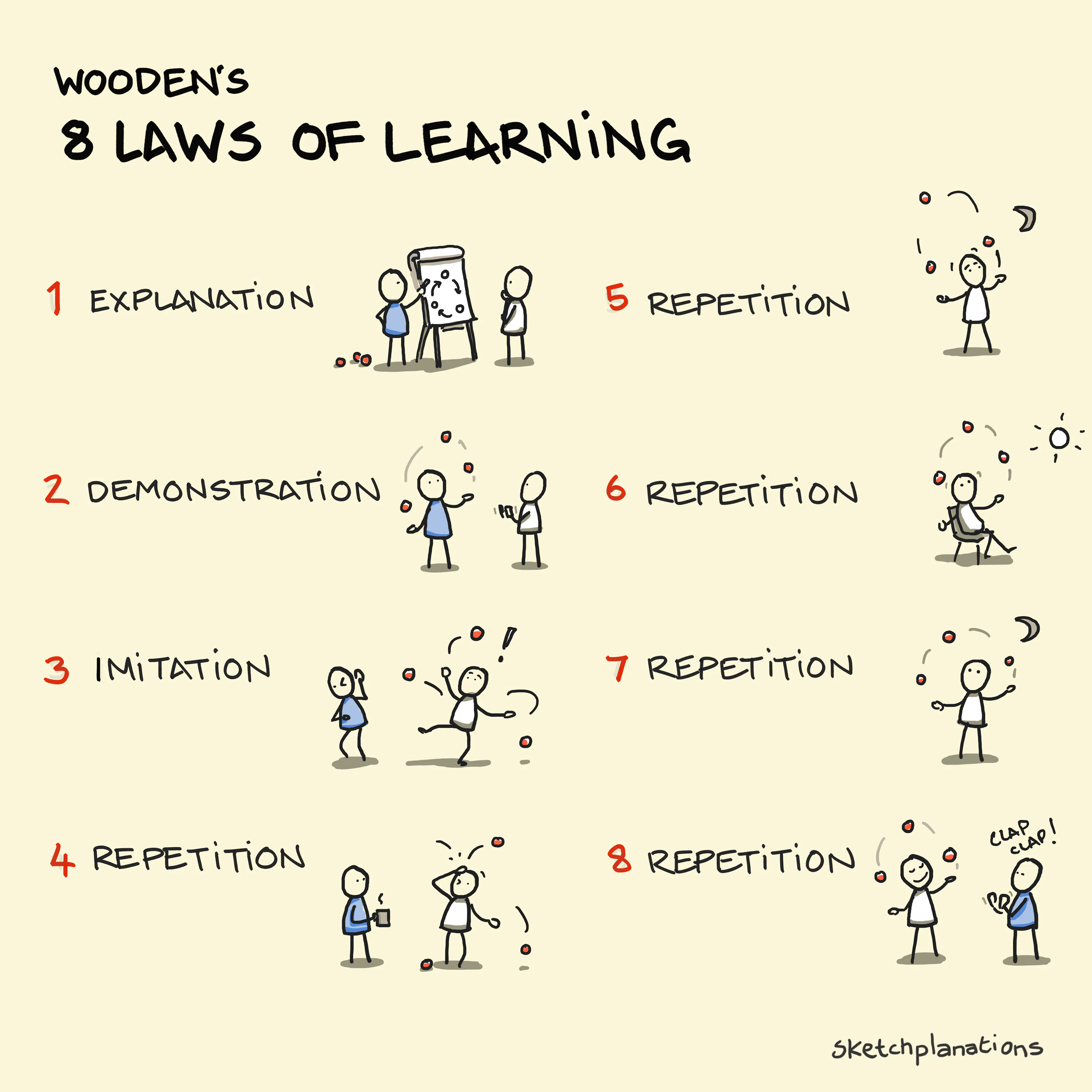 Wooden's 8 Laws of Learning
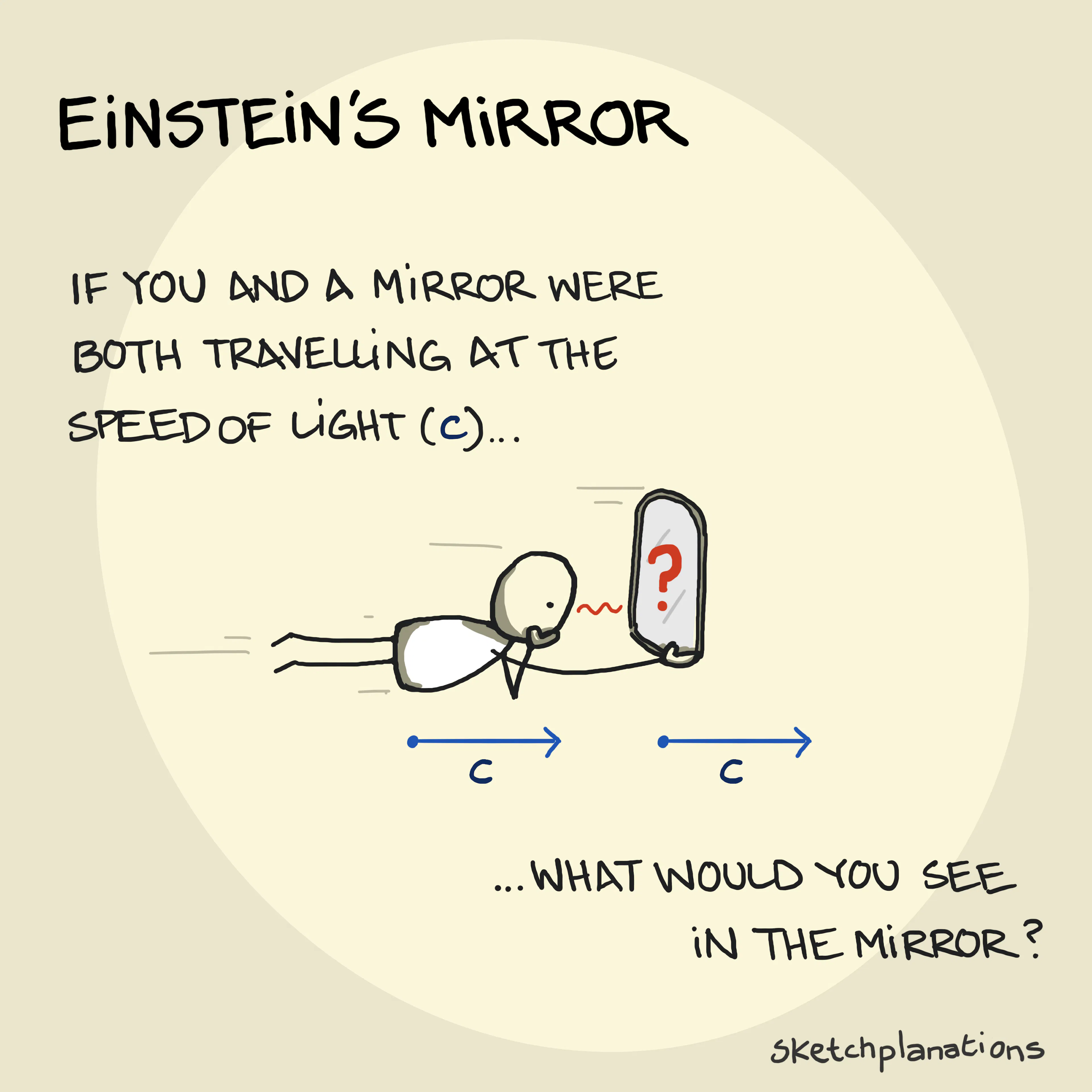 Einstein's MirrorView all
5-star rated on Amazon!
Absorb big ideas with crystal-clear understanding through this collection of 135 visual explanations. Including 24 exclusive new sketches and enhanced versions of classic favourites, each page shares life-improving ideas through beautifully simple illustrations.
Perfect for curious minds and visual learners alike.
See inside the book